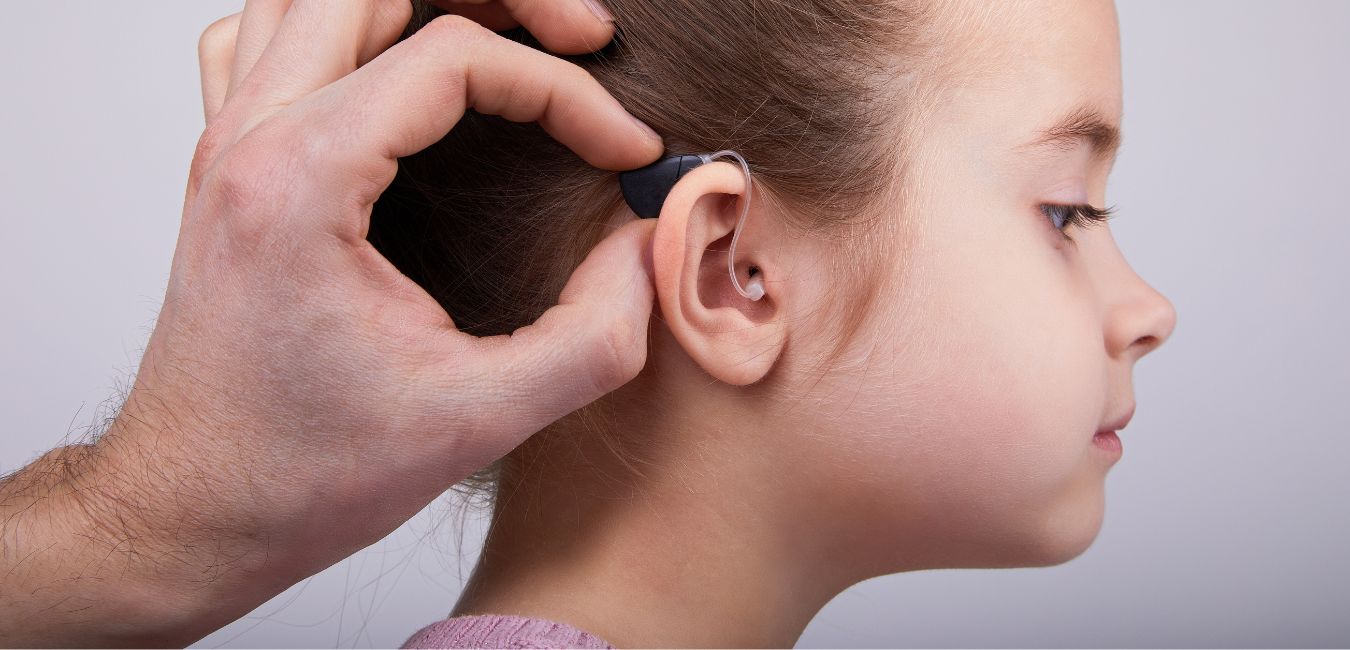

The evolution of audiology: from large hearing aids to invisible hearing aids in Alicante
For decades, hearing aids were synonymous with bulky, flesh-coloured devices visible from several metres away. That image now belongs to the past. Electronic miniaturisation, low-consumption microprocessors and state-of-the-art biocompatible materials have made it possible to create devices so small that they literally disappear inside the ear canal.
Today, most patients who come to our clinic in Alicante arrive with the same question: “Is there such a thing as a hearing aid that cannot be seen?” The answer is yes, and it has two specific names: IIC and CIC.
What is an IIC hearing aid? Invisibility taken to the extreme
The IIC model (Invisible-In-the-Canal) is currently the smallest hearing aid on the market. Its name says it all: it is inserted so deeply into the external ear canal that it reaches the second bend of the canal, remaining completely hidden from view. From the outside, even when looking directly into the ear, it is virtually impossible to detect.
Technical features of the IIC:
- Insertion position: second bend of the ear canal, just a few millimetres from the eardrum.
- Size: approximately that of a small coffee bean, although it varies according to each patient’s custom mould.
- Manufacture: 100% custom-made, based on an exact impression of your ear canal.
- Removal: by means of a small thread or pull-tab that is invisible from the outside.
- Battery life: between 3 and 5 days with a size 10A zinc-air battery, the smallest in the sector.
Its deep position is not only an aesthetic advantage: because it sits so close to the eardrum, sound pickup is more natural and the occlusion effect (that sensation of “hearing your own voice in a tunnel”) is reduced, whereas it can occur with other models.
What is a CIC hearing aid? Power and discretion in balance
The CIC model (Completely-In-the-Canal) sits in the first bend of the ear canal and only just appears in the canal opening, without protruding from the outer ear. It is slightly larger than the IIC, which allows it to incorporate more powerful components and a higher-capacity battery.
Technical features of the CIC:
- Insertion position: first bend of the ear canal, in the outermost part of the canal.
- Visibility: minimal; the faceplate (the outer cover) matches the tone of the skin or the inside of the ear canal.
- Power: suitable for mild to moderately severe hearing loss.
- Battery: size 312, with a battery life of 5 to 7 days.
- Connectivity: some CIC models now include low-energy Bluetooth for pairing with smartphones.
If the IIC is the option for those who prioritise invisibility above all else, the CIC is the solution for those who need slightly greater acoustic performance without sacrificing discretion.
The advantages of invisible technology: far more than aesthetics
Choosing an in-the-canal hearing aid is not simply a cosmetic decision. These devices offer genuine functional advantages that behind-the-ear models cannot replicate:
1. Natural sound capture
Because they sit inside the canal, the outer ear can do its full job: naturally filtering, amplifying and locating sound, just as it would in an ear without hearing loss. Spatial sound localisation improves significantly compared with external models.
2. Full compatibility with glasses and telephones
There is no device behind the ear to interfere with the arms of your glasses. And when speaking on the telephone, the handset fits perfectly over the ear without feedback or interference.
3. Comfort in active environments
They are ideal for active people, sports enthusiasts or professionals who take frequent video calls. They do not shift with movement and do not pick up wind noise with the same intensity as external models.
If you live in the Marina Baixa area and are looking for this cutting-edge technology near you, you can visit our hearing centre in El Albir, where we carry out personalised assessments to determine whether these models are suitable for your anatomy.
Are you an ideal candidate for an invisible hearing aid?
This is the key question, and honesty is essential here. Not every patient is suitable for IIC or CIC models, and at Centro Auditivo La Marina we always prioritise the right solution over the most eye-catching one. The determining factors are:
Degree of hearing loss
Invisible hearing aids are suitable for mild, moderate and moderately severe hearing loss. If your hearing loss is profound or extremely severe, the power you need exceeds what a device of this size can provide, and a behind-the-ear model with a larger receiver will be the most appropriate option.
Shape and size of the ear canal
This is the most important factor and the one that varies most between patients. The canal must have sufficient diameter to house the device comfortably and create an effective acoustic seal. Very narrow canals, highly curved canals or canals with particular anatomical shapes may not be compatible with an IIC. That is why a professional ear impression is essential.
Manual dexterity
IIC and CIC devices are small. If you have reduced finger mobility, arthritis or sight problems that make it difficult to handle tiny components, it may be necessary to consider a model with assisted removal or to rethink the option.
Health of the ear canal
Excessive earwax production can block the microphone or receiver of an in-the-canal device. This does not automatically rule out the option, but it does require a stricter hygiene and maintenance routine.
The process at Centro Auditivo La Marina: from audiometry to the perfect mould
Being fitted with invisible hearing aids in Alicante is not something you can do online or at a general optical retailer. It requires a precise clinical process that we follow step by step in our clinic:
1. Complete audiometry: we carry out a thorough assessment of your hearing: pure-tone audiometry, speech audiometry and tympanometry. We need to know your hearing loss curve at each frequency exactly.
2. Otoscopic examination: we check the condition of the ear canal and eardrum to confirm there are no contraindications or active pathologies.
3. Model selection: based on your results and anatomy, we advise you on which model (IIC or CIC) and which brand best suit your needs. We work with the leading brands on the market: Phonak, Oticon, Widex, Signia and Starkey, among others.
4. Ear canal impression: using medical-grade silicone material, we make an exact mould of your ear canal. This impression is sent to the manufacturer’s laboratory so the hearing aid can be made exclusively for you.
5. Initial fitting: when the device arrives, we carry out personalised audiological programming using professional software and verify both the physical and acoustic fit.
6. Follow-up and fine-tuning: we book you in again after two and four weeks to make any necessary adjustments. Adapting to an in-the-canal hearing aid requires an adjustment period, and we are with you every step of the way.
Maintenance and care of your invisible hearing aid
Its small size requires careful daily cleaning:
- Always use the cleaning brush provided to remove earwax from the microphone and receiver.
- Store the device at night in its dehumidifying case to remove accumulated moisture.
- Change the receiver’s anti-moisture filters every 4–6 weeks according to the manufacturer’s instructions.
- Avoid contact with water, creams or hair sprays.
- Attend a professional check-up every 6 months for a deep clean.
Frequently asked questions about invisible hearing aids
Book your invisible hearing aid trial in Alicante — with no obligation
If you have read this far, it is because discretion matters. And at Centro Auditivo La Marina, we understand that need perfectly. With years of experience supporting patients in Alicante and across the province, our team of hearing care audiologists will combine the most advanced technology with completely personalised care.
We invite you to book your free hearing assessment, during which we will carry out a full audiometry test, examine your ear canal and assess with you whether IIC or CIC models are the solution you are looking for. You will be able to try the device in the clinic and see the difference for yourself.