
Understanding the differences between in-the-ear, behind-the-ear and RIC hearing aids is essential if you want to discover which option is best according to your hearing loss and your particular needs. When someone comes to a consultation and asks, “Which is the best model on the market?”, the honest answer is always the same: it depends.
That final choice is shaped by very personal factors: from the degree of your hearing loss and the anatomy of your ear canal, to your lifestyle and your manual dexterity. In the end, it is all about balancing your priorities, whether you are looking for total invisibility, maximum power or easy connectivity with your devices.
In-the-ear hearing aids (ITE, ITC and CIC)
What are they like and how do they work?
In-the-ear hearing aids are those that sit completely inside the ear. Depending on how deeply they are inserted into the ear canal, they are given different names:
- ITE (In-The-Ear): fills the concha of the outer ear. It is the largest of the three and the only one visible at a glance.
- ITC (In-The-Canal): fits into the entrance of the ear canal. It is only visible when looking directly into the ear.
- CIC (Completely-In-the-Canal): fits into the first bend of the canal. It is virtually imperceptible from the outside.
All of them are custom-made from an impression of the patient’s ear canal, which ensures a personalised anatomical fit.
Advantages
- Discreet appearance: because they are housed inside the ear, they are not visible in everyday situations.
- Compatibility with telephones and headphones: there is no body behind the ear to get in the way when placing a mobile phone or over-ear headphones over the ear.
- Natural sound pickup: the outer ear acts as a natural filter, improving sound localisation.
- No interference with glasses: they completely eliminate incompatibility with the arms of the frame.
Limitations
- Limited acoustic power: the small size restricts the size of the loudspeaker and amplifier, which sets a ceiling on gain.
- Occlusion effect: in many patients, sealing the canal produces the sensation of “hearing your own voice in a bucket” or perceiving internal sounds (chewing, swallowing) in an uncomfortable way. This can be minimised with appropriate venting, but it cannot always be eliminated completely.
- More demanding maintenance: their proximity to earwax requires rigorous daily cleaning.
- Manual dexterity required: their small size can make insertion and removal difficult for people with arthritis or fine motor problems.
Who are they ideal for?
In-the-ear hearing aids are mainly recommended for:
- Mild to moderate hearing loss (up to approximately 60–65 dB HL).
- Patients who prioritise cosmetic discretion.
- Active adults with good manual dexterity.
- People who use the telephone frequently or play sport.
Behind-the-ear hearing aids (BTE)
What are they like and how do they work?
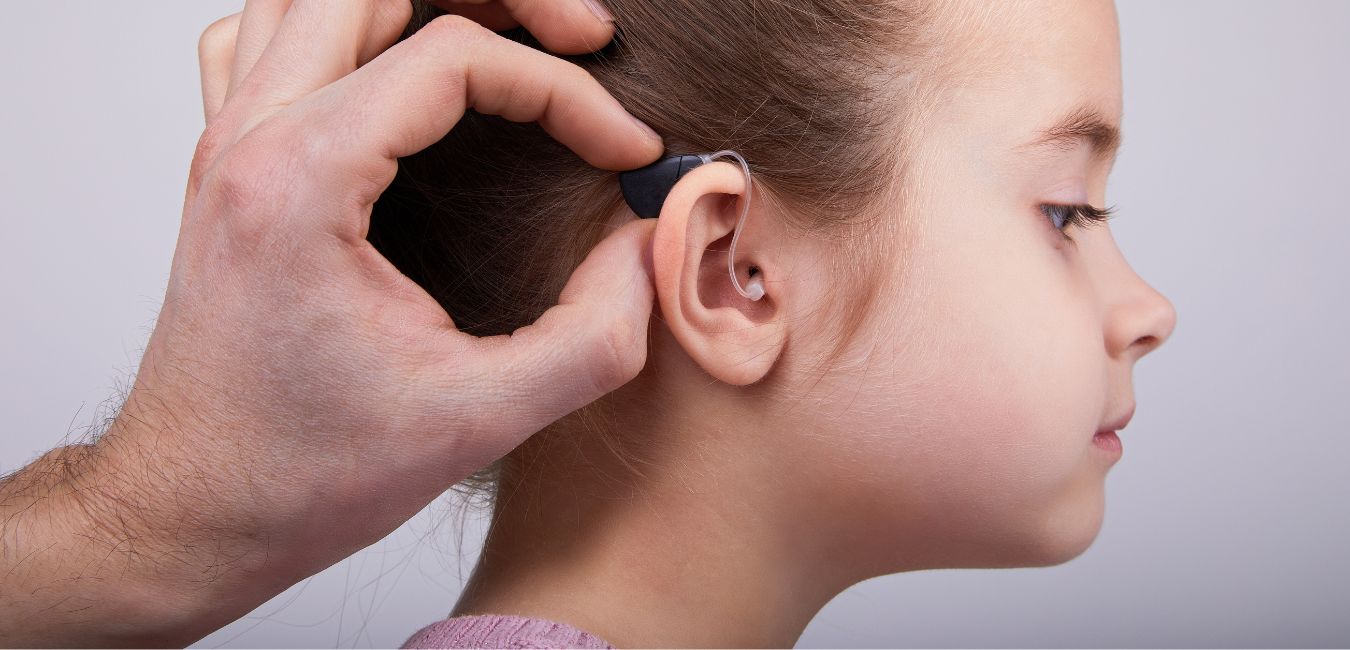
BTE (Behind-The-Ear) hearing aids are the classic model in audiology. The body of the device — where the microphone, processor and battery are housed — rests on the upper part of the outer ear, behind the ear. From there, an acoustic tube carries the amplified sound to a custom-made earmould, which fits into the canal.
There are two main variants:
- Standard BTE: thick tube and silicone earmould. Greater power and durability.
- Mini BTE: smaller body and thin tube (slim tube). More discreet, although with slightly less power than the standard version.
Advantages
- Maximum acoustic power: because they have more room for components, BTE devices can generate the gain needed for severe and profound hearing losses.
- Greater durability: their size allows for larger batteries and more robust casings.
- Ease of handling: the larger body makes them easier to insert, remove, clean and programme. This is a critical advantage for older people or those with manual dexterity difficulties.
- Connectivity: current models incorporate Bluetooth, inductive charging and integration with mobile apps.
- Simpler maintenance: the earmould is detachable and easy to clean.
Limitations
- Greater visibility: because they sit behind the ear, they are the most visible of all categories.
- Incompatibility with glasses: the arm of the frame can interfere with the body of the device, especially in standard models.
- Wind noise pickup: the external microphone, located behind the ear, is more likely to pick up ambient noise outdoors.
Who are they ideal for?
BTE hearing aids are the first choice for:
- Severe or profound hearing loss (above 70–80 dB HL).
- Children and teenagers, because of their ease of adjustment as the ear canal grows and their robustness.
- Older people with manual dexterity difficulties.
- Patients with very narrow or malformed ear canals that do not allow the insertion of an in-the-ear device.
RIC hearing aids (Receiver-in-Canal)
What are they like and what is the key difference?
RIC (Receiver-In-Canal) hearing aids are currently the most commonly prescribed model worldwide, and that is no coincidence. Their design elegantly solves the main drawbacks of both in-the-ear and behind-the-ear devices.
The key innovation lies in separating the receiver (earpiece) from the body of the hearing aid:
- The body — microphone and processor — rests discreetly behind the ear and is considerably smaller than a classic BTE.
- The receiver (the loudspeaker that delivers the amplified sound) travels through an almost invisible thin wire and sits directly inside the ear canal.
This separation has very important acoustic implications.
Advantages
- More natural, higher-fidelity sound: because the receiver sits inside the canal, the signal reaches the eardrum without loss or acoustic colouring.
- Significant reduction of the occlusion effect: thanks to the use of domes (open or vented silicone tips), the canal is not completely sealed, which in most cases eliminates the sensation of a blocked ear.
- Very discreet design: the body of the device is small and the wire connecting it to the receiver is almost invisible.
- Wide power range: depending on the receiver fitted (available in S, M, P and UP power levels), they can cover everything from mild to moderately severe hearing loss.
- Easy receiver replacement: if the earpiece is damaged or becomes blocked with earwax, it can be replaced easily without having to send the device back to the manufacturer.
- Advanced connectivity: virtually all current RIC models incorporate Bluetooth for direct streaming from iPhone, Android and television.
Limitations
- Sensitivity to earwax: because the receiver sits inside the canal, it can become blocked with wax. Protective filters reduce this risk, but they require periodic replacement.
- Connecting wire: although thin and discreet, the wire linking the body to the receiver can bend or deteriorate over time.
- Not suitable for profound hearing loss: although high-power receivers do exist, very profound losses usually require the full canal seal provided by a classic BTE earmould.
Who are they ideal for?
The RIC model is particularly suitable for:
- Presbycusis (age-related hearing loss): characterised by a drop in high frequencies with relatively preserved low frequencies. RIC open domes amplify the high frequencies without occluding the canal, preserving natural low-frequency hearing.
- Mild to moderately severe hearing loss.
- Patients looking for a balance between discretion and technological performance.
- People who frequently make calls or stream audio.
Final comparison: differences between in-the-ear, behind-the-ear and RIC hearing aids
Feature | In-the-ear (ITE/ITC/CIC) | Behind-the-ear (BTE) | RIC |
|---|---|---|---|
Visibility | Very low / invisible | High (visible behind the ear) | Low (discreet) |
Maximum power | Limited (mild–moderate) | Very high (severe–profound) | Medium-high (mild–moderately severe) |
Occlusion effect | Possible (variable) | Possible (depends on earmould) | Minimal (open domes) |
Compatibility with glasses | Excellent | Limited (may interfere) | Good |
Ease of handling | Difficult (small size) | Easy (larger size) | Moderate |
Bluetooth connectivity | Limited / not available in IIC | Available in mid- to high-range models | Standard in almost all models |
Maintenance | Demanding (earwax) | Simple (detachable earmould) | Moderate (receiver replacement) |
Ideal for | Mild to moderate hearing loss | Severe to profound hearing loss / children | Presbycusis / mild to moderately severe hearing loss |
Manufacture | 100% custom-made | Custom earmould + standard body | Standard dome or custom earmould |
Audiometry: your starting point
Understanding the differences between in-the-ear, behind-the-ear and RIC hearing aids is valuable, but no article can replace what a full professional audiometry assessment reveals in just 30 to 45 minutes: your exact tonal curve, your speech understanding threshold, the condition of your middle ear and the anatomical particularities of your ear canal.
The ideal hearing aid for you is not determined by the brand, the price or fashion. It is determined by the intersection of your audiogram, your anatomy, your daily needs and your lifestyle. And that combination can only be properly assessed by a hearing aid audiologist with the right equipment and experience.
If you have doubts about your hearing or have been postponing a check-up for some time, this is the best moment to act. Untreated hearing loss has a real impact on cognition, social relationships and quality of life — and the earlier it is addressed, the better the fitting outcomes tend to be.
At Centro Auditivo La Marina, we have specialist professionals who will guide you through every step of the process, from the initial audiometry assessment to the fitting and follow-up of your device. If you are in the Marina Alta area, you can visit us at the Senti2 Moraira hearing centre, where we combine first-class hearing technology with a warm, personalised approach.