Home › Guides › Types of hearing aids
By Sandra Meyer, hearing care professional (Spanish qualification: audioprotesista), registration no. 2822, Professional College of Higher Health Technicians of the Valencian Community · Published 7 October 2026
There are three main types of hearing aid: two sit behind the ear and one goes inside it. The smallest, often called ‘invisible’, fit deep in the ear canal and don’t suit everyone. This guide explains what each type is like, what decides which one you can wear and what it means day to day.
1. The three types at a glance: where each one sits and how much it shows
| Type | Where it sits | How much it shows |
|---|---|---|
| Behind-the-ear (BTE) | Behind the ear, with a tube to the ear | A little more visible |
| RIC | Behind the ear, small, with a thin wire to the ear | Very little |
| In-the-ear | Inside the ear, custom-made or in a standard size | Little or almost nothing, depending on the size |
2. Behind-the-ear (BTE): what it is like and who it usually suits
It sits behind the ear. The sound reaches the ear through a tube, often with a custom-made earmould.
It is often chosen when a lot of power is needed, when the ear often has discharge, or when you want an aid that is easy to hold and to clean. It is the sturdiest type.
3. Receiver-in-canal (RIC): behind the ear, with the speaker in the ear canal
This is the type most often fitted today. The body of the hearing aid is small and sits behind the ear. A very thin wire carries the sound to a small speaker that sits inside the ear canal.
It suits most types of hearing loss, from mild to severe, and almost all models can be recharged and connected to your phone.
4. In-the-ear, including the so-called ‘invisible’ ones (CIC and IIC): what decides whether you can wear one
They go inside the ear. There are several sizes, from largest to smallest:
- ITE (full shell): fills the visible part of the ear.
- ITC: smaller, at the entrance to the ear canal.
- CIC: sits in the ear canal; very little of it shows.
- IIC: the smallest, deep in the ear canal. This is the one usually called ‘invisible’.
Most are custom-made from an impression of your ear, which we take at any of our three hearing centres. There are also small models in a standard size that can be fitted the same day.
What decides whether you can wear one:
- The size and shape of your ear canal. If it is narrow or very curved, the smallest one may not fit.
- How much hearing loss you have. The smallest ones have less power.
- Ventilation. An aid that blocks the whole ear canal can make your ear feel blocked, or make your own voice sound ‘hollow’.
- Earwax and moisture. In ears with a lot of wax they wear out sooner.
- Your hands and your eyesight. The smaller it is, the harder it is to put in, take out and change the battery.
That is why we say ‘very discreet, if your ear allows it’. We look at this at the first appointment.
Free hearing test. We spend between an hour and an hour and a half on the first appointment. It doesn’t hurt, there’s no obligation and at the end we explain the results to you.
About the hearing test5. Rechargeable or disposable batteries: what changes day to day
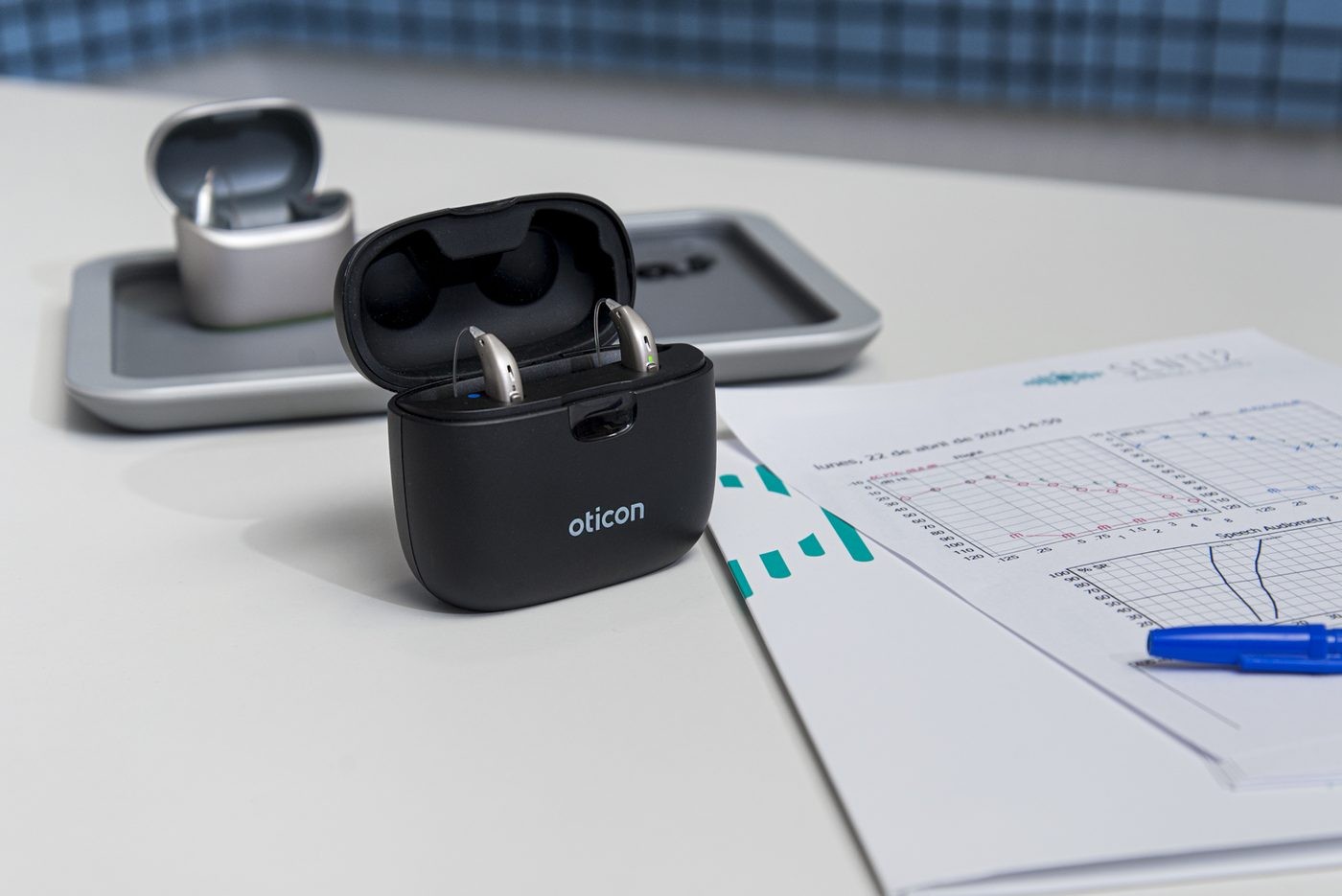
Rechargeable aids go in their charger overnight and are ready in the morning. There are no batteries to change, which is what many people find hardest.
Aids with disposable batteries don’t need a plug socket. They are handy for travelling without a charger, or if you would rather not depend on one.
Today almost all RIC and behind-the-ear aids come in a rechargeable version. There are fewer rechargeable in-the-ear models, and not in every size.
6. If small parts are fiddly or hard to see: which types are easier to handle
If you find small things hard to pick up, or you can’t see well close up, these usually work better:
- a rechargeable aid, so you don’t have to change batteries;
- a size that is easy to hold;
- a simple charger, where you just drop the aid in.
Before you decide, you try it at the hearing centre: you put it in, take it out and charge it yourself.
7. Phone and TV: which hearing aids can connect, depending on type and model
Many hearing aids connect to your phone by Bluetooth. That way you hear calls directly in both ears. For the television there are small accessories that send the sound to your hearing aid.
Not every model can do this, especially the smallest in-the-ear ones. If it matters to you, tell us and we’ll keep it in mind when choosing.
8. How we help you choose: hearing first, looks second
First we look at how you hear, with the full hearing test. Then we look at your ear, your daily life and what matters to you. With that, we show you the options that suit you, and you try them before you decide.
We work with all brands, with no exclusive deals. So we can choose the hearing aid for what you need, not for the brand.
Our team prepares these guides with the help of artificial intelligence tools; a registered hearing care professional reviews and approves them before publication.